
"coffee polishing"
1000 article(s) found

Scottish Cafe Teaching mathematicians Banach and Uram
Famous Polish mathematicians Banach and Uram famous Polish mathematicians Banach and Ulam are the main members of a certain mathematics school. They like cafes very much, soaking for more than ten hours, even the mathematical Banach space and the outline of Banach algebra have the smell of coffee. They worked hard to write on the table with pencils all over the profound math masters.

Chanel finally opened a time-limited coffee shop in Shanghai, but the real deal was lip lotion and nail polish.
Coco Caf Interior at the intersection of Nanjing West Road and Huashan Road in Jing 'an District, Shanghai City Source: Chanel In addition to inviting stars to advertise and promote, how can makeup be sold? Especially in this age of social media, how can offline channels and online user sharing form a complementary cycle? Chanel's play this time is in downtown Jing 'an, Shanghai

Technology of high-quality coffee beans the processing process of coffee beans
After the wet treatment, the coffee beans are still preserved in the inner pericarp, which still contains about 15% water. The endocarp must be dried to a moisture content of about 11% to ensure that coffee beans are stored in a stable and safe environment. Water content is critical, because if Arabica beans are overdried to a moisture content of 10%, they will be lost

Tiamo brand coffee brewing utensils: stainless steel long mouth thin mouth pot dripping hand brewing coffee pot 700ML
Brand: TIAMO gross weight: 1 item number: 1 coffee pot classification: fine pot material: stainless steel model: HA1594 material: stainless steel capacity: 700cc mirror polished stainless steel outer 7mm fine mouth nozzle design the latest welding technology: argon arc welding! Bottom magnetic conductive stainless steel suitable for both commercial and household use: mirror stainless steel polished outer layer: beautiful and elegant shape, showing exquisite

The refined processing of coffee beans includes roughing, separation, classification, fermentation, drying, shelling and throwing.
The refined processing of coffee beans includes eight processes, such as rough processing, separation, classification, fermentation, drying, shelling, polishing, sorting and so on. There are two ways to prepare coffee beans for the baking process. The method chosen has a significant impact on the final value and quality of coffee. The cheapest method of processing is called drying, which is used for lower coffee beans and higher quality coffee beans.

The Coffee Encyclopedia details the six wonderful uses of coffee grounds
After drying the coffee grounds, put them into silk stockings and use them to polish the floor so that you can achieve the effect of waxing. Many white-collar women like to drink coffee. Do you know what good it is to make leftover coffee grounds? As an aroma agent, coffee grounds are packed in containers, put in toilets, refrigerators, shoe cabinets, and thrown into the dustbin to act as fragrances to eliminate odors and dehumidify. Remove the stench of smoke

Buy a drink and sit all day. Are you an Olympic guest? The rule of Taiwan cafes is low, which is the rule of Polish bosses.
Professional coffee knowledge exchange more coffee bean information Please follow the coffee workshop (Wechat official account cafe_style) recently read an online news article in Taiwan with third-grade students, mainly saying that in this customer-oriented era, because each service staff wants to meet the needs of consumers as much as possible, so unwittingly cultivate a lot of "Olympic guest"

The process of picking and growing of Coffee
Coffee picking growth picking: most of them are picked manually. Only ripe coffee berries of similar size are picked so that the peeling machine can handle them. Cleaning: soak the coffee berries in water in order to remove overripe coffee berries. Coffee berries that are not ripe enough will be removed in other ways. Peeling: coffee berries are softened in water and treated in a peeling machine
Coffee in Vienna
Latte and music in Vienna was attacked by the Turkish army for the second time in 1683. At that time, the Viennese emperor Obode I and the Polish king Augustus II had an offensive and defensive alliance. As long as the Poles knew this news, the Polish army would arrive quickly, but the question was, who would break through the Turkish siege and send messages to the Poles? Once in Turkey.

Introduction to the quality characteristics of Brazilian coffee bean picking season flavor description treatment method
Brazilian coffee bean picking: most of them are picked manually. Only ripe coffee berries of similar size are picked so that the peeling machine can handle them. Cleaning: soak the coffee berries in water in order to remove overripe coffee berries. Coffee berries that are not ripe enough will be removed in other ways. Peeling: coffee berries are softened in water and treated in a peeling machine.
On the treatment of coffee beans after picking
When the fruit of the coffee tree is picked, the four layers of skin wrapped around the coffee beans need to be removed in order to finally get the coffee beans needed. The main methods to remove the outer epidermis of coffee beans are "wet treatment" and "dry treatment".

Points for attention in Coffee planting
When the fruit of the coffee tree is picked, the four layers of skin wrapped around the coffee beans need to be removed in order to finally get the coffee beans needed. The main methods to remove the outer epidermis of coffee beans are "wet treatment" and "dry treatment".
On the processing of coffee beans
There are two ways to prepare coffee beans for the baking process. The method chosen has a significant impact on the final value and quality of coffee. The cheapest method of processing is called "drying", which is used for lower-grade coffee beans, while higher-quality coffee beans are processed by "wet treatment".

Introduction to the processing methods of coffee beans from growing to picking raw beans and ripe beans
The growth process of coffee beans introduces the natural treatment of raw coffee beans (dry processing): also known as drying processing. After the coffee berries are fully ripe, they will fall from the tree. After natural drying, the coffee beans will come out of the coffee berries and become mature coffee beans. This is probably the earliest way to process coffee beans. Later, this method evolved into drying processing.

Coffee common sense what is the processing of coffee beans
There are two ways to prepare coffee beans for the baking process. The method chosen has a significant impact on the final value and quality of coffee. The cheapest method of processing is called drying, which is used for lower-grade coffee beans, while higher-quality coffee beans are processed by wet treatment. Drying is used for unwashed coffee beans. Wet treatment used for thorough cleaning or semi-cleaning.
Fine Coffee Science explains the processing of coffee beans in detail
There are two ways to prepare coffee beans for the baking process. The method chosen has a significant impact on the final value and quality of coffee. The cheapest method of processing is called drying, which is used for lower-grade coffee beans, while higher-quality coffee beans are processed by wet treatment. Drying is used for unwashed coffee beans. Wet treatment used for thorough cleaning or semi-cleaning.
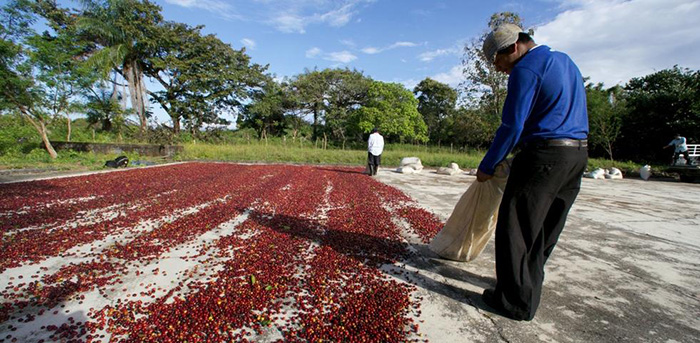
Processing of coffee beans which method is suitable for different coffee beans
There are two ways to prepare coffee beans for the baking process. The method chosen has a significant impact on the final value and quality of coffee. The cheapest method of processing is called drying, which is used for lower-grade coffee beans, while higher-quality coffee beans are processed by wet treatment. Drying is used for unwashed coffee beans. Wet treatment used for thorough cleaning or semi-cleaning.
Life Tips 6 wonderful uses of coffee grounds
After drying the coffee grounds, put them into silk stockings and use them to polish the floor so that you can achieve the effect of waxing.
The origin of the history of lattes in coffee
The first person to add milk to the coffee was Kochsky of Vienna, who also opened the first coffee shop in Vienna.

Espresso powder filling technique espresso filling method espresso filling procedure
Professional coffee knowledge exchange more coffee bean information please follow the coffee workshop (Wechat official account cafe_style) if you want to consistently make a good espresso, you need to have an excellent tamping. This video tutorial will serve as a getting started guide. Follow the steps below to practice. Through practice, your espresso will get better and better. Good condition and stability are you.